



- Kaspa is trading near $0.0435, with low volatility and possible downward pressure ahead.
- The RSI at 37.36 indicates Kaspa may be near oversold conditions, signaling a potential reversal.
- Liquidity levels around $0.04 could provide support, influencing short-term price movement.
Kaspa (KAS) is currently trading at around $0.0435, showing a slight uptick of 1.14%. Despite this modest increase, the price is hovering near the lower Bollinger Band, indicating low volatility.
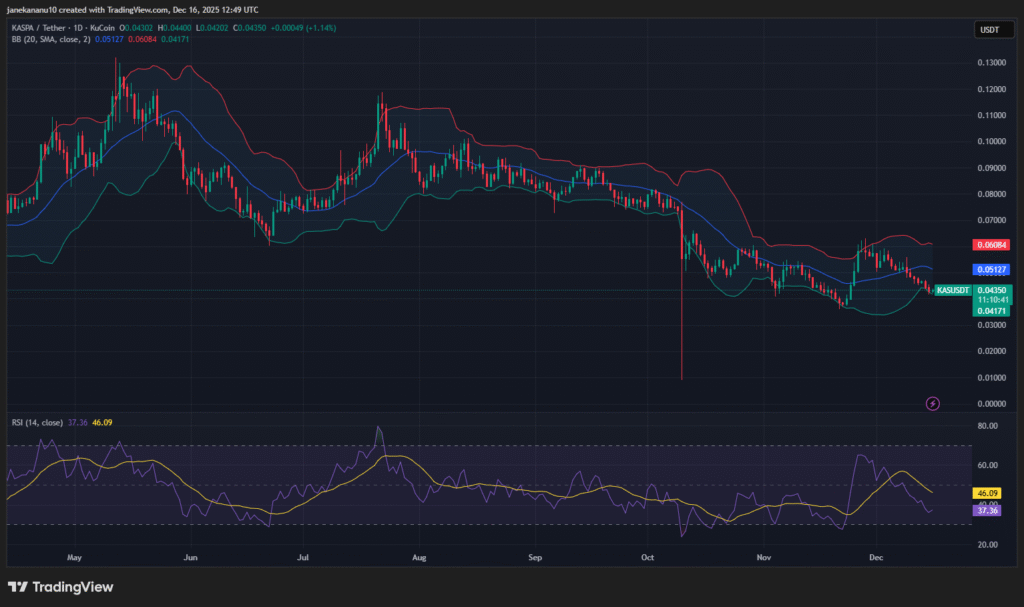
This suggests the potential for further downside pressure if the current trend continues. The Relative Strength Index (RSI) stands at 37.36, nearing oversold conditions. This signals a possible price reversal or consolidation in the near future.
Price Levels and Resistance
Kaspa’s price action is currently constrained by key resistance levels. If the price stays below $0.0512, downward momentum may persist. This level has acted as a barrier for upward movement in the recent past. A closely for any signs of a breakout above this resistance, which could shift momentum toward the upside.
The Bollinger Bands are also signaling low volatility, which typically precedes a more significant price movement. However, without a clear breakout above resistance or a fall below support, the price is likely to remain in a tight range.
Liquidity Zones and Market Sentiment
Kaspa’s liquidity dynamics show a clear bifurcation in the market. On the upside, there is notable liquidity up to the $0.06 level.
However, the primary liquidity cluster is found below $0.04, suggesting strong support in this range. If the price continues its downward trend, the downside liquidity will become an important factor to watch.
The direction of Kaspa’s price in the short term will largely depend on which liquidity zone is tested first. A move towards the $0.04 support zone could provide stability, while a breakout above $0.0512 could lead to upward momentum.
Disclaimer: This article is for informational purposes only and does not constitute financial advice. CoinCryptoNewz is not responsible for any losses incurred. Readers should do their own research before making financial decisions.