


- Altcoin market cycles evolved significantly between 2017 and 2021
- Analysts expect selective sector rotation during the 2025 and 2026 cycle
- Liquidity may favor utility-driven crypto sectors over speculative projects
The altcoin market has moved through several major cycles over the past decade, each shaped by different investor behavior and liquidity conditions. Data from Altcoinmarketcap and analysis shared by pseudonymous analyst 𝕄𝕠𝕦𝕤𝕥𝕒𝕔ⓗ𝕖 on X highlight how the market evolved from the explosive 2017 rally into the more structured 2021 cycle.
Altcoin Market Cycles Changed Between 2017 and 2021
The 2017 altcoin market rally was largely driven by retail speculation. Investors poured capital into nearly every crypto project, creating massive price surges across the sector. Initial coin offerings dominated headlines, while many lower-cap assets posted exponential gains in a short period.
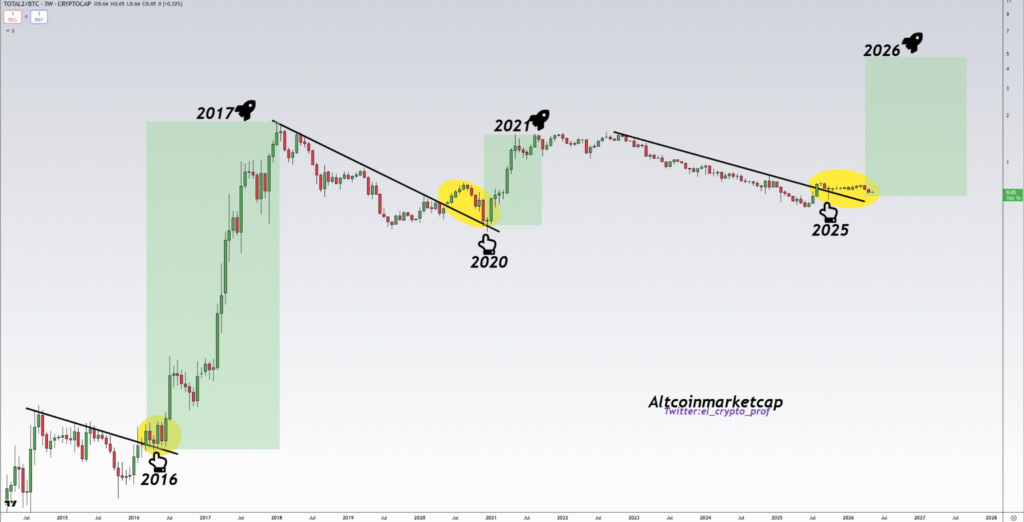
By 2021, the altcoin market had evolved significantly. Decentralized finance and NFT ecosystems attracted new users and larger capital inflows. While volatility remained high, the cycle showed stronger infrastructure development and broader adoption compared to previous years.
Analysts tracking historical patterns on X noted that the 2021 cycle also introduced stronger sector-based rotation. Instead of every asset rallying equally, liquidity is concentrated around trending narratives such as gaming tokens, Layer-1 networks, and decentralized exchanges.
Altcoin Market Projection Suggests Selective Rotation Ahead
Looking toward 2025 and 2026, analysts expect the altcoin market to become even more segmented. Rather than a broad-based rally similar to 2017, capital may rotate selectively into sectors with stronger utility, adoption, and institutional relevance.
Crypto analysts believe artificial intelligence tokens, blockchain infrastructure, and tokenized real-world assets could attract a larger share of market liquidity. At the same time, weaker speculative projects may struggle to capture the same momentum seen during earlier cycles.
Market participants also highlighted that total altcoin market capitalization could still expand meaningfully despite reduced parabolic returns. The difference lies in how liquidity spreads across the ecosystem.
Disclaimer: This article is for informational purposes only and does not constitute financial advice. CoinCryptoNewz is not responsible for any losses incurred. Readers should do their own research before making financial decisions.