


- Standard Chartered retains its $2 trillion target but pushes the forecast from 2028 to 2030.
- Monthly raw transfer volume averages nearly $10 trillion despite stalled supply growth.
- USDC faces growing competition in payments, while regulation could reshape issuer advantages.
Standard Chartered has pushed its $2 trillion stablecoin market forecast to 2030 from 2028 after supply growth stalled. The bank estimates outstanding supply at roughly $309 billion, despite increasing transaction activity. Geoffrey Kendrick, its global head of digital assets research, outlined the revised timeline in an October 14 report, retaining the target while extending the expected growth period.
Stablecoin market growth slows while token usage expands
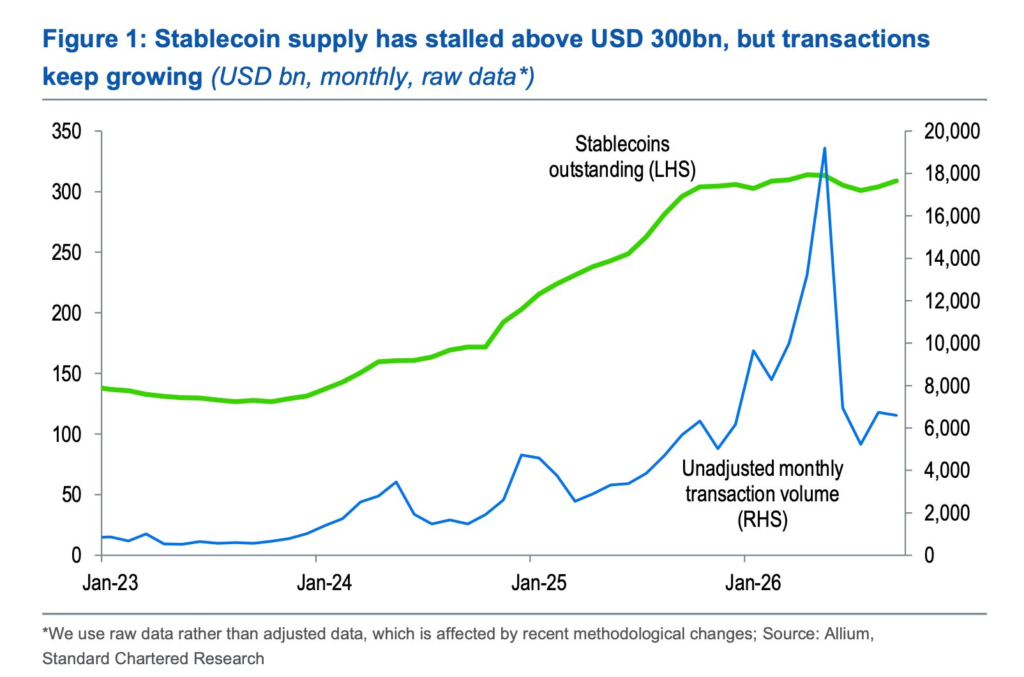
Stablecoin supply has stayed between $300 billion and $320 billion over the past year. Kendrick attributes the stagnation to weak crypto activity rather than a lasting deterioration in demand.
He pointed to earlier periods when supply recovered alongside broader crypto markets. That interpretation underpins the bank’s decision to preserve its longer-term stablecoin market target.
Meanwhile, raw monthly on-chain transfers averaged nearly $10 trillion this year, compared with $4 trillion in 2025. May recorded a peak of $19 trillion.
These figures measure token movements, rather than purchases of goods and services alone. A dollar transferred repeatedly can generate substantial volume without increasing the amount of stablecoins outstanding.
Kendrick said average monthly velocity doubled to approximately 30 transfers per dollar, illustrating that distinction. Faster circulation helps explain why activity can rise while supply remains broadly unchanged.
Stablecoin market competition shifts toward payment services
The bank highlighted different patterns for the two largest issuers. USDT’s monthly velocity remained around seven, while USDC’s increased to approximately 80 from 45 in 2025.
Kendrick associates USDT primarily with dollar savings in emerging economies. He links USDC more closely with payments, financial transactions and early settlement between AI agents.
Competition could reshape the stablecoin market as institutions pursue those transactional uses. Potential challengers include Open USD, infrastructure provider M^0 and the planned A+ banking network.
The commercial question extends beyond adoption to who retains income earned on reserves. Banks and distribution partners may seek arrangements that give them a greater share.
Kendrick also identified regulation as a risk to his forecast. He said wider adoption of rules resembling the U.S. GENIUS Act could challenge USDT’s emerging-market position.
Disclaimer: This article is for informational purposes only and does not constitute financial advice. CoinCryptoNewz is not responsible for any losses incurred. Readers should do their own research before making financial decisions.