



- Bitcoin posted a rare 17% November decline, marking its weakest monthly performance since 2019 and breaking its historically strong seasonal pattern.
- Despite the month’s downturn, Bitcoin holds firm around $91,000 as trading volume drops and the market enters a clear consolidation phase.
- The token’s recent behavior aligns with earlier periods of macro pressure, suggesting the market may be preparing for its next decisive move.
Bitcoin ended November with an unexpected setback as it recorded its weakest monthly performance in six years. The token closed the period with a sharp 17 percent fall, and the decline marked its poorest November result since 2019. However, the price now steadies near the $91,000 zone, and the market observes a phase of consolidation.
Bitcoin’s November Performance Shows a Clear Shift
Bitcoin moved against its usual trend as November often delivers strong gains for the digital asset. The token has averaged notable monthly increases for more than a decade, and many market participants long viewed November as a supportive period. Yet, the latest downturn shows a different picture and signals changing momentum.
The historical data highlights years where Bitcoin posted strong double-digit surges. The heatmap from earlier cycles shows mostly green patches during November, and several years produced impressive jumps. But this month broke that pattern and added pressure to a period known for strength.
Some of Bitcoin’s earlier standout Novembers include 2013 and 2017, and both years saw major surges. The recent decline instead aligns with weaker periods seen in 2018, 2019, and 2022, and those episodes also unfolded during broad market headwinds. Therefore, the sharp reversal points to external pressure and shifting sentiment.
Bitcoin Price Holds Near $91K After Volatile Trading
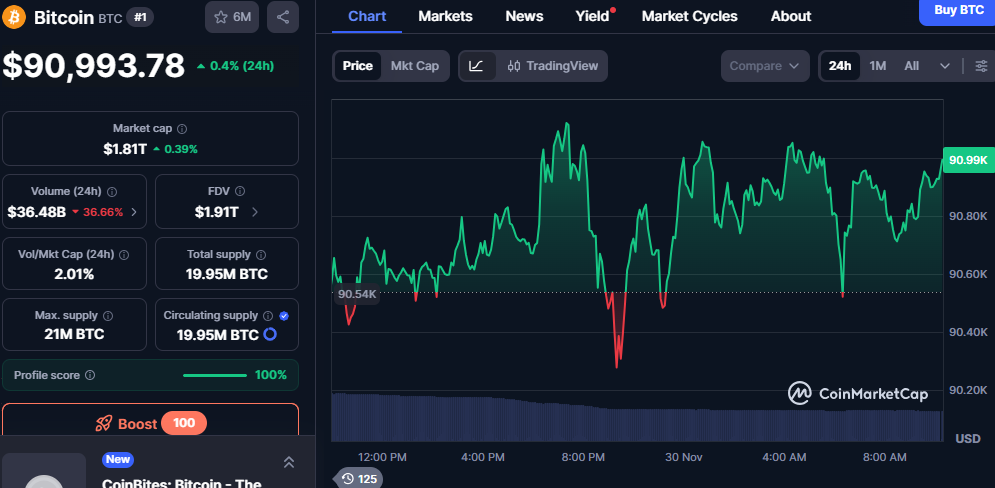
Bitcoin now trades close to $90,993 and posts a slight 24-hour increase despite its recent drop. The price chart shows a series of fast moves across the day, and the range stays between $90,400 and $90,900. Even so, this movement signals a consolidating phase rather than a clear trend.
Source: CoinMarketcap
The market cap remains stable at $1.81 trillion, and Bitcoin continues to lead the sector with strong dominance. The 24-hour volume, however, fell sharply by more than 36 percent, and the decline reflects reduced participation in the short term. Yet, the pattern fits typical consolidation conditions after a volatile month.
Bitcoin’s supply now reaches 19.95 million units, and the remaining gap to 21 million supports its long-term scarcity model. The volatility index stands at 2.01 percent, and the slight dips on the chart appear quickly absorbed. Thus, the price shows resilience even as the market slows down.
Context and Market Outlook for Bitcoin
Bitcoin’s current position near $91,000 acts as both a support and resistance point. The consolidation suggests the token awaits a clear catalyst, and past cycles often showed similar pauses before bigger moves. Moreover, the subdued activity indicates market participants may be reassessing conditions after November’s rare decline.
Background trends reveal that Bitcoin often reacts strongly to external economic shifts. The latest weakness may reflect cooling momentum after several active months, and such periods sometimes precede renewed volatility. Furthermore, seasonal trends have occasionally broken during uncertain macro phases.
Bitcoin now enters December with a mixed setup as the asset balances its long-term pattern with short-term pressure. The current range highlights stability despite November’s sharp loss, and the coming sessions may set the next direction. As a result, Bitcoin remains firmly in focus as the market transitions into the final month of the year.
Disclaimer: This article is for informational purposes only and does not constitute financial advice. CoinCryptoNewz is not responsible for any losses incurred. Readers should do their own research before making financial decisions.