


- About 28.83% of staked SOL went offline during the routing failure.
- Solana came roughly 4.5 percentage points from losing transaction finality.
- Only three of 74 measured validators switched to backup infrastructure.
The Solana network came within 4.5 percentage points of losing transaction finality after a routing failure disrupted validators. Marinade Finance found 28.83% of staked SOL went offline during the incident.
That left the chain close to the 33.34% delinquency threshold. SOL traded near $76.46, up 0.6%, while the market showed little immediate reaction.
Solana Network Routing Failure Exposes Finality Risk
Solana uses Tower BFT, which needs about two-thirds of staked SOL participating to finalize transactions. If more than 33.34% goes offline, the chain can lose finality even while blocks continue.
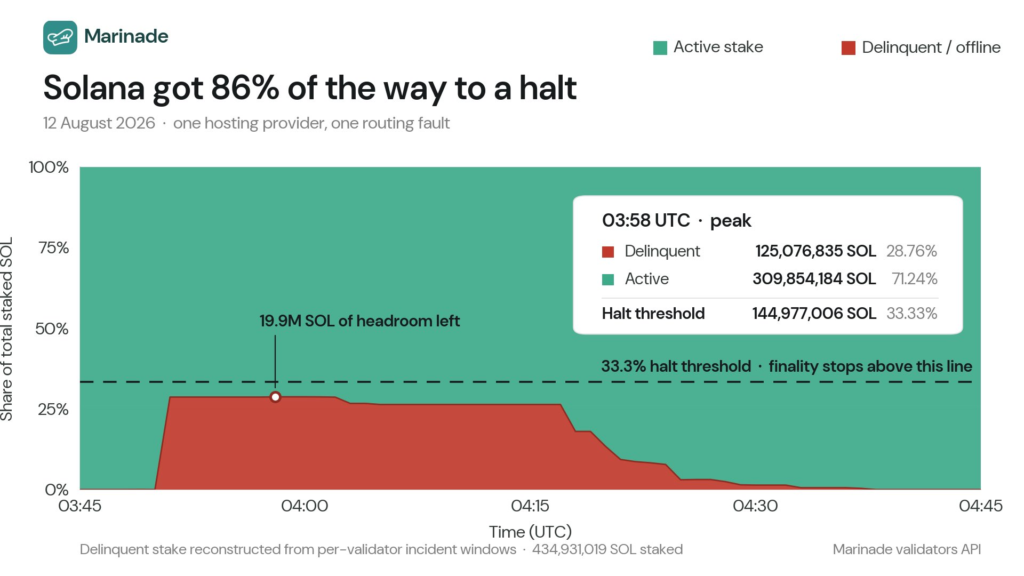
For the Solana network, 28.83% offline meant only a narrow buffer remained before finality became vulnerable. The failure began at Teraswitch, where a bad route affected Miami and spread through an internal relay in Amsterdam.
Twelve locations later lost connectivity, while around 90 validators went delinquent. Marinade estimated roughly 20 million SOL separated the network from the finality boundary.
At the peak, AS20326 hosted 27.34% of total staked SOL. Marinade says 94% of that stake went offline together. That concentration exceeds the Solana Foundation Delegation Program 25% cap for any single ASN.
Solana Network Validator Concentration Raises New Questions
Backup systems also showed limited resilience across the Solana network. Only three of 74 validators measured by Marinade switched automatically to another site. Helius, the second-largest validator, stayed offline for the full 33-minute disruption.
Validators lost 333 SOL in rewards, worth about $25,600 at cited prices. Solana does not slash validators solely for downtime, so operators mainly lose rewards. Validator bonds are expected to cover these losses.
The Solana network has avoided a full outage since February 2024, but this incident exposed a different risk. A chain can keep producing blocks while failing to finalize them. That distinction matters for applications that depend on irreversible settlement.
Meanwhile, developers are preparing Alpenglow, which targets roughly 100 to 150 millisecond finality. The upgrade prioritizes safety over liveness during faults. Marinade also plans tighter ASN and data-center limits, plus public reporting on automatic validator failover.
Disclaimer: This article is for informational purposes only and does not constitute financial advice. CoinCryptoNewz is not responsible for any losses incurred. Readers should do their own research before making financial decisions.